Chapter 5 · Robust, Scalable Recovery
The USF-ARA Algorithm
The proof of Theorem 2 assumes ideal, on-grid folds. Real hardware adds thermal noise and non-ideal folds, and audio arrives in millions of samples. USF-ARA works frame by frame. In each frame, the first difference is a smooth part plus a sparse train of spikes. The DCT separates the two: the audio compacts into low indices, and the spikes spread into every index as cosines. Recover the spikes from the out-of-band coefficients, sum them into the residue, and add it back.
Why the DCT, and Why Out-of-Band
Within frame \(l\), the noisy measurements decompose as \(\bar y_{l}=\bar g_{l}-\bar\varepsilon_{l}+\bar q_{l}+\bar w_{l}\) (bars denote first differences). In the DCT domain (eq. (14)),
where \(\widehat{\bar g}_l[k]\approx0\) for \(k\ge K\) (energy compaction), and \(\widehat{\bar\varepsilon}_l\) is a sum of cosines, one per spike \(c_m\delta[n-n_m]\). So the out-of-band coefficients \(k\in[K,N_g-2]\) see only the residue and noise. Recovering the residue is a frequency-estimation problem (eq. (16)): spike locations are frequencies, spike heights are amplitudes.
The DCT rather than the DFT: a finite frame is not periodic, and the DFT's implied wrap-around leaks audio energy into every bin. The DCT's even extension avoids the jump at the frame edge, so the audio stays compact.
Algorithm 1 · USF-ARA
- for frames \(l=1,\dots,L\):
- DCT of \(\bar y_l\), keep \(k\ge K\) (eq. 13)
- model order \(\widetilde M=|\{n:|\bar y_l[n]|>\epsilon\}|\) (eq. 25)
- fit \(\mathsf P/\mathsf Q\) by iterative weighted LS (eqs. 18–23)
- roots of \(\mathsf Q\) → \(\{c_m,n_m\}\) (eq. 24)
- rebuild \(\bar\varepsilon_l\); concatenate
- anti-difference → \(\varepsilon\); \(\tilde g\leftarrow\yq+\varepsilon\)
In this demo, line 3–4 is replaced by greedy on-grid matching of cosines to the out-of-band coefficients, with amplitudes snapped to \(2\lambda\Z\). The paper's rational-model fit is more robust to non-ideal folds.
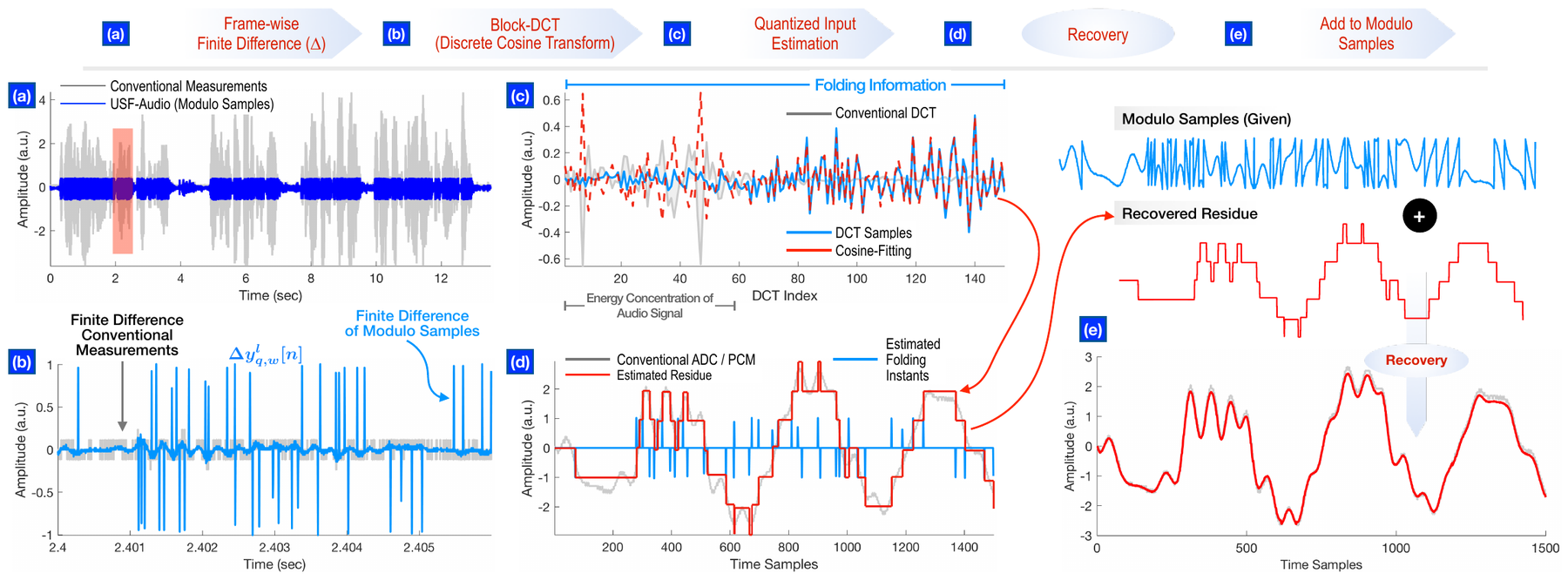
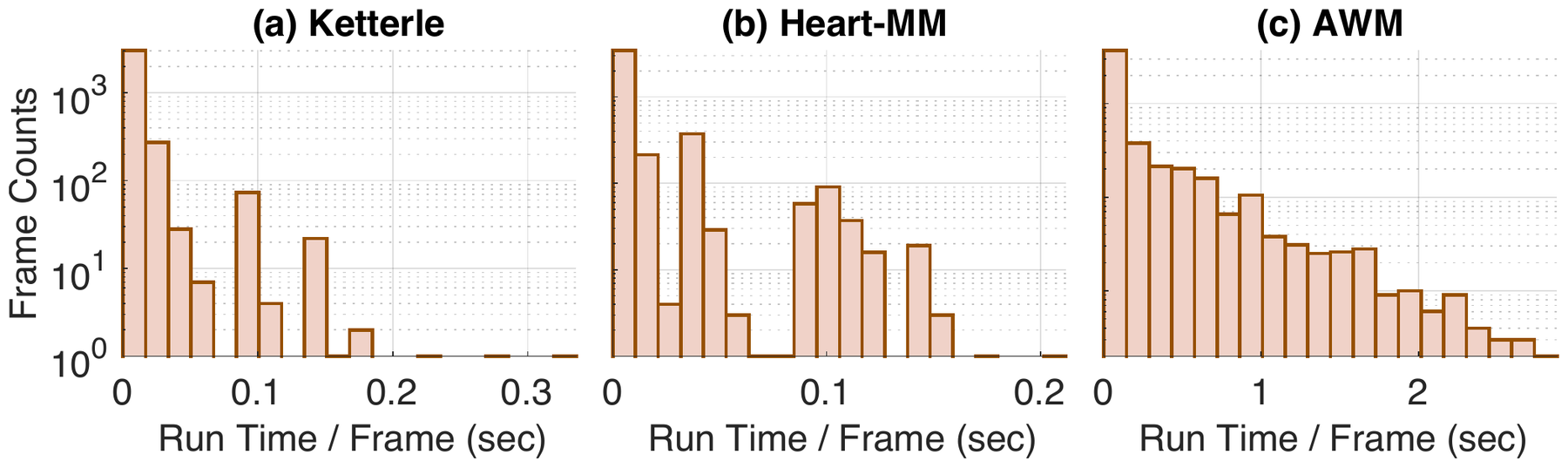
In the paper Section IV: frame-wise model, eqs. (13)–(25), Algorithm 1, model-order estimation with \(\epsilon=0.5\lambda\), error mitigation; Section V-F (run time).
Simulation: 1500 samples of a bandlimited signal with \(\Omega T=\pi/\OF\), scaled to \(\DRX\cdot\lambda\) with \(\lambda=0.5\); ideal folds, \(B\)-bit quantization, then additive Gaussian noise \(w\). Frames of \(N_g=300\) samples (299 differences). The band edge is set from the known bandwidth: \(K=\lceil(N_g-1)/\OF\rceil\) plus a 4% guard. Spike count per frame follows eq. (25) with \(\epsilon=0.5\lambda\); greedy matching stops early when the best amplitude rounds to 0. The recovered signal is shown with the unrecoverable global offset taken from the truth.