Sampling Is Not the Problem
For \(g\in\BL\) (bandlimited to \(\Omega\)) and \(T\le\pi/\Omega\), the samples \(g(nT)\) determine \(g\) exactly. All loss in PCM happens in amplitude.
Chapter 1 · The Analog–Digital Interface
Every digital audio pipeline begins with pulse-code modulation (PCM): sample uniformly in time, then quantize uniformly in amplitude. Under the Shannon–Nyquist criterion sampling loses nothing. Quantization does, and any sample beyond the converter's range is lost entirely. With \(B\) bits spread over \([-R,R]\), the step is \(2R/(2^B-1)\): widen the range to avoid clipping and every step coarsens; narrow it and the peaks clip. Explore this trade-off below.
For \(g\in\BL\) (bandlimited to \(\Omega\)) and \(T\le\pi/\Omega\), the samples \(g(nT)\) determine \(g\) exactly. All loss in PCM happens in amplitude.
A uniform quantizer with step \(\Delta=2R/(2^B-1)\) leaves an error \(|e|\le\Delta/2\). Each extra bit halves \(\Delta\), so the signal-to-quantization-noise ratio grows as
L1, limited dynamic range: samples with \(|g|>R\) saturate, and clipping is not invertible. L2, range–resolution trade-off: for fixed \(B\), raising \(R\) coarsens \(\Delta\); lowering it clips. No choice of \(R\) escapes both, as the right-hand plot shows.
These limits originate at acquisition and propagate through every later layer of the audio processing stack: no downstream algorithm can restore information that was never digitized. Declipping, dithering and noise shaping all work after the loss. Are the limitations algorithmic, or rooted in how we sense audio in the first place? Chapter 2 changes the sensing.
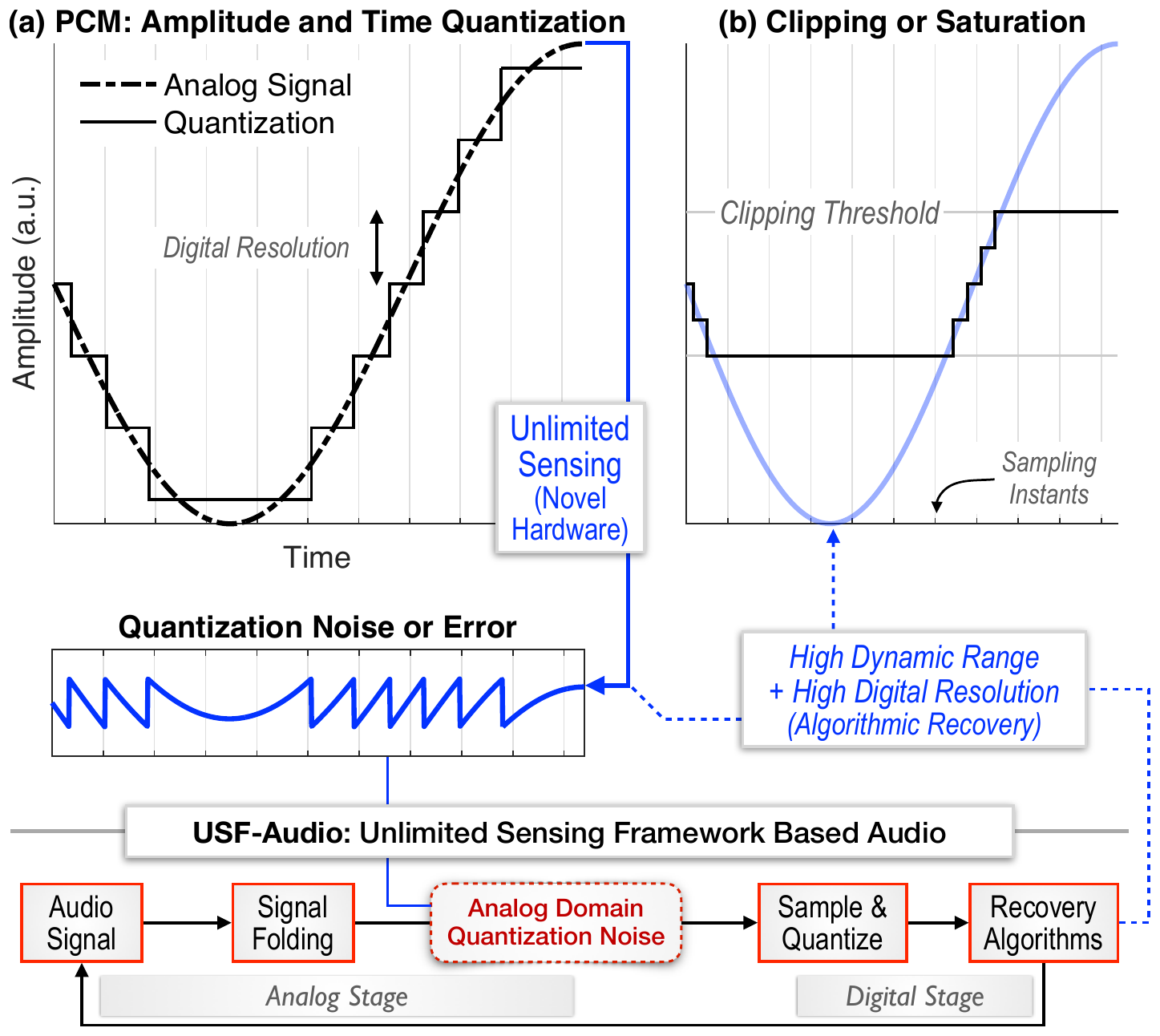
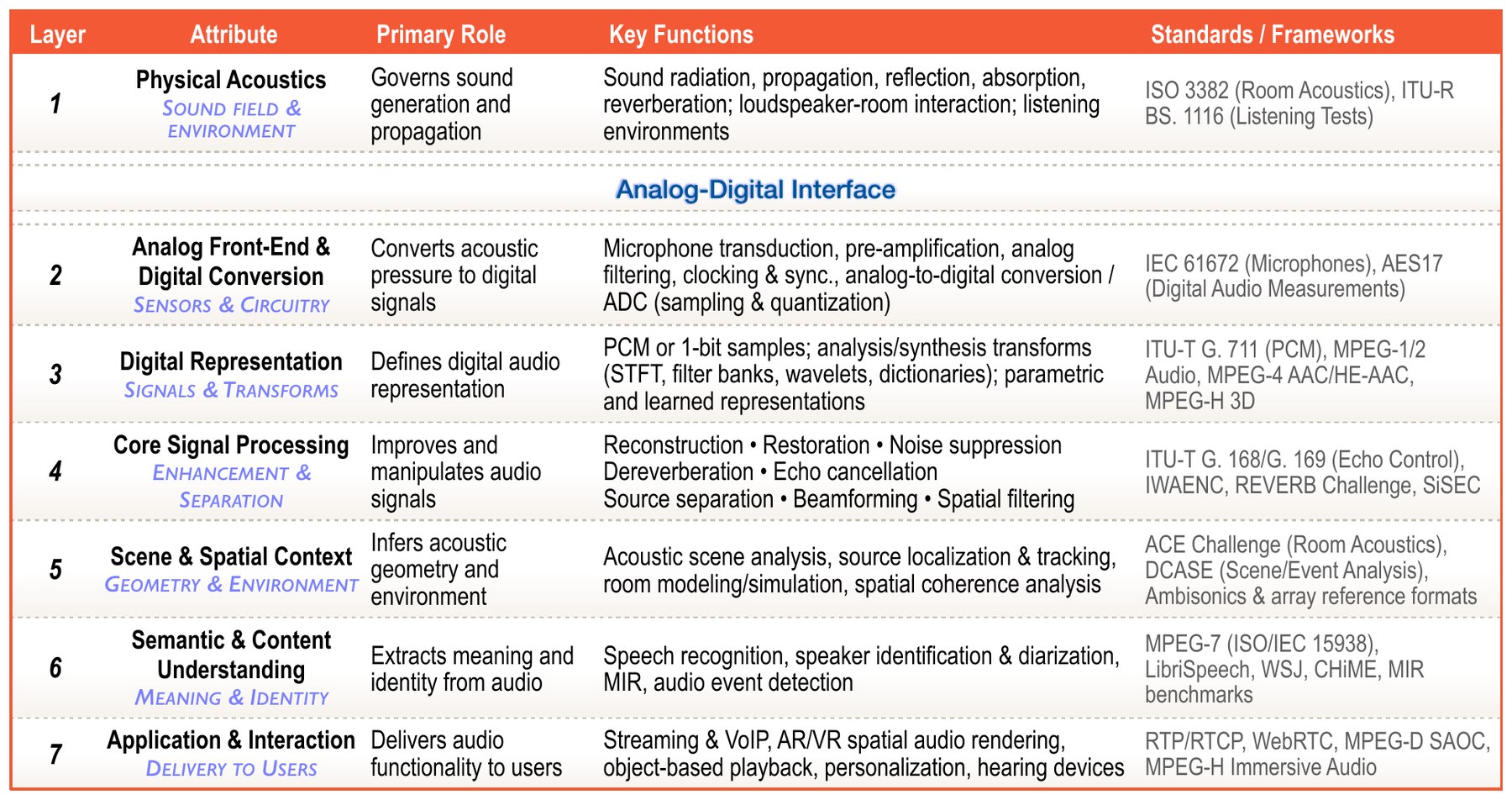
In the paper Section I-B (L1, L2), Fig. 1 (PCM and its limitations), eq. (1) and the “6-dB per bit rule.”
Test signal: a fixed sum of shifted sincs bandlimited to \(\Omega=\pi\) rad/s, sampled at \(T=0.25\) s (four times oversampled), normalized to \(\norm{g}_{\infty}=1\). PCM: \(\mathrm{PCM}[n]=\Delta\,\mathrm{round}\bigl(\mathrm{clip}_R(g[n])/\Delta\bigr)\) with \(2^B\) levels in \([-R,R]\). SNR \(=20\log_{10}(\norm{g}_2/\norm{g-\mathrm{PCM}}_2)\) over the window shown.