poem shop


developed
Erik Blankinship
information: organized
MIT Media Laboratory, USA
and
Dr. Richard Beckwith
Intel Corporation


summary & papers
Most text-to-speech software allows the user to select a voice, but provides no control over performance parameters such as rate, volume, and pitch. For users with vocal disabilities, the default computer voice is often dreaded since it provides no personalization. Thus we created an easy to learn text-to-speech markup tool that requires little training.

Excerpt above from: Blankinship, E. & Beckwith, R. (2001). Tools for Expressive Text-To-Speech Markup. Proceedings of the 14th Annual Symposium on User Interface Software and Technology. New York: ACM Press.


video
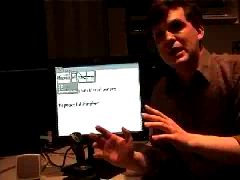
A short video demo of poem shop is available [~13megabytes].


sample audio
This is an mp3 introduction to a web site. Not much of a poem, but it does allow you to hear the audio output from poem shop generated from this file.


download
poem shop only runs on Windows 2000, XP, +. There is no support available for this software. E-mail me to discuss how to get a copy.


background
poem shop was developed at Intel Corporation's People and Practices group in January 2001. My host was Dr. Richard Beckwith.

Richard introduced me to Portland State University's Disabilities Center and their patron Art Honeyman. Art shared his poetry with us and it was quite good. My own family is from the Portland area and knew of Art Honeyman by name; he is a well known Portland character. Despite being an accomplished poet, Art could not perform his poetry aloud because of severe cerebral palsy. Richard and I saw an opportunity to build something that would enable Art to score his poetry much like a musical score.

To inform our design, we observed poets in performance and also interviewed poets. The best of these interviews was over dinner with Portland's own Walt Curtis.

We also consulted with the folks at the Oregon Graduate Institute. Our poem shop software works using their SABLE markup system.

After some time, Richard gave a demo of the software to the physicist Stephen Hawking. Hawking is set on keeping his own synthetic voice, as he now feels it is "his" voice, but liked the software. For what its worth, Richard found that real Hawking likes the work of MC Hawking.